330.252.8188
 Uniontown, OH
 330.252.8188
 Uniontown, OH



Senior fitness classes can provide structured opportunities to improve strength, balance, flexibility, and overall movement. However, a class designed for older adults is not automatically suitable for every participant. Its pace, starting positions, balance demands, instructor support, and available modifications can vary considerably.
The right class should reflect the older adult’s current mobility, health considerations, experience, and comfort. Before enrolling, it helps to understand what the class includes, how movements can be adapted, and what support is available.
What Should a Senior Fitness Class Include?
A well-rounded fitness routine may involve several types of movement. According to the CDC’s physical activity guidelines for older adults, adults age 65 and older should generally include aerobic activity, muscle-strengthening activity, and exercises that improve balance in their weekly routines. Activity should also be adjusted to the individual’s abilities and health conditions.
Senior fitness classes may emphasize one area or combine several:
- Strength activities use resistance to work major muscle groups. Depending on the class, resistance may come from light weights, exercise bands, body weight, or controlled movements.
- Balance activities may involve changing position, shifting weight, or maintaining stability with or without support.
- Aerobic movement raises the heart rate through continuous activity appropriate to the participant’s ability.
- Flexibility and mobility activities use controlled movement to support a comfortable range of motion.
- Multicomponent activities combine areas such as balance, strength, aerobic movement, gait, and physical function.
The Physical Activity Guidelines for Americans recognize multicomponent activity as an important part of an active routine for older adults.
A class does not need to include every component in every session. Older adults may participate in different activities throughout the week to create a more balanced routine.
How to Choose a Class That Matches an Older Adult’s Mobility
A class title offers only limited information. Terms such as “gentle fitness,” “senior yoga,” or “balance class” can describe very different formats. Families and prospective participants should look closely at how the class is conducted.
Consider the starting position
Ask whether movements are completed:
- Seated in a chair
- Standing with a chair, wall, or rail for support
- Standing independently
- Moving between seated and standing positions
- On the floor
A participant who is comfortable with seated movement may not be ready for repeated standing transitions or floor-based exercises. Someone who moves independently may prefer a class that offers an appropriate level of challenge.
Ask about pace and transitions
Being able to perform one movement does not always mean a participant can comfortably follow an entire class. Consider how quickly the instructor changes exercises and whether participants have enough time to reposition themselves.
Frequent turns, rapid direction changes, or quick transitions from sitting to standing may be difficult for someone who uses a mobility aid or needs additional time.
Look for meaningful modifications
A useful modification should make a movement more appropriate without pressuring the participant to work beyond their abilities. Ask whether exercises can be completed seated, with stable support, through a smaller range of motion, or with lighter resistance.
Modifications should also be explained clearly. Participants should not have to guess how to make an exercise safer or more comfortable.
Respect rest and personal limits
A suitable class should allow participants to pause when needed. Pain, dizziness, unusual shortness of breath, sudden weakness, or unsteadiness are reasons to stop rather than push through the movement.
An older adult with a health condition, recent fall, injury, significant mobility change, or long period of inactivity may need guidance from an appropriate healthcare professional before beginning or changing an exercise routine.
Questions to Ask Before Joining a Senior Fitness Class
Speaking with the instructor or program coordinator can reveal more than the class name or description. Useful questions include:
- Is the class seated, standing, or a combination of both?
- Are stable chairs, rails, or other supports available?
- Can each movement be modified?
- How long is the class, and how quickly does it move?
- Is previous fitness or yoga experience needed?
- What equipment will participants use?
- Are rest breaks built into the session?
- How does the instructor support participants with different mobility levels?
- What should someone do if a movement causes pain or unsteadiness?
- Can a prospective participant observe a class before joining?
- Does the instructor have experience working with older adults and varied mobility needs?
These questions cannot replace individualized medical advice, but they can help families determine whether a class appears compatible with the participant’s current abilities.
Comparing Common Types of Senior Fitness Classes
| Class type | Common emphasis | What to ask about |
| Strength class | Resistance and major muscle groups | Can the resistance, position, and range of motion be adjusted? |
| Balance class | Stability, weight shifting, and controlled movement | What stable support is available during standing activities? |
| Gentle or chair yoga | Mobility, controlled strength, balance, and breathing | Can movements be completed seated or with support? |
| Low-impact aerobic class | Continuous movement at a reduced impact level | What pace and standing tolerance does the class require? |
| Multicomponent class | Strength, balance, mobility, and aerobic movement | How are activities adapted for different ability levels? |
No single format is best for every older adult. The most appropriate choice is one that provides a manageable challenge while respecting the participant’s current mobility and limits.
How Yoga for Seniors Can Support an Active Routine
Yoga for seniors may involve flexibility, controlled strength, balance, breathing, and relaxation. Some programs take place entirely in a chair, while others include supported standing or movement between positions.
Because formats vary, families should ask what poses and transitions are used rather than assuming that every class described as gentle is equally accessible. A chair yoga class may suit someone who prefers seated movement, while another participant may be comfortable with a combination of seated and supported standing activities.
For more guidance on class formats, modifications, and safety considerations, explore yoga for seniors.
How Strength and Balance Activities Relate to Fall Prevention
Fall prevention exercises for seniors commonly focus on areas such as balance, leg strength, gait, mobility, and functional movement. Federal research on physical activity and fall prevention for older adults indicates that effective multicomponent programs often combine several of these areas rather than relying on one exercise alone.
That does not mean every general fitness or balance class is a complete fall-prevention program. Fall risk may also be influenced by health conditions, medications, vision, footwear, the home environment, and other factors.
Someone who has recently fallen, developed new unsteadiness, or experienced a significant mobility change should discuss the situation with an appropriate healthcare professional. A clinical assessment or individualized therapy may be more suitable than relying solely on a group class.
Readers looking for practical movement examples can review these balance exercises for seniors.
How Often Should Older Adults Participate in Fitness Activities?
The CDC’s recommendations for adults age 65 and older generally include:
- At least 150 minutes of moderate-intensity aerobic activity each week
- Muscle-strengthening activity on at least two days each week
- Activities that improve balance
Older adults who cannot meet the full recommendations should remain as active as their abilities and health conditions allow.
This does not mean someone must attend the same class every day or complete the entire recommendation through group fitness. A weekly routine might combine classes, walking, recreational activities, and appropriate movement at home.
The right class frequency depends on:
- The intensity and length of each session
- Other activities completed during the week
- Current fitness and mobility
- Recovery needs
- Health conditions
- Guidance from a healthcare professional when appropriate
Consistency matters, but participation should remain appropriate to the individual. Beginning with a manageable schedule may be more useful than doing too much too quickly.
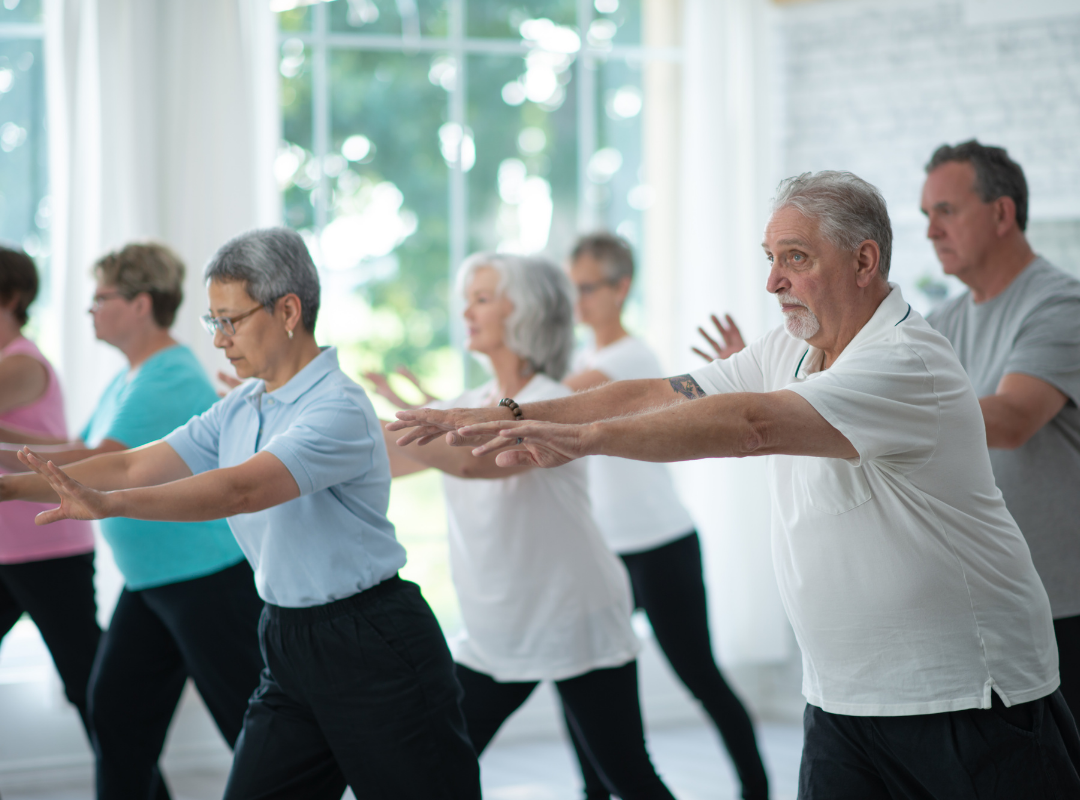
Fitness and Wellness at The Gables of Green
The Gables of Green offers yoga classes and balance and strength fitness classes as part of its activities in Uniontown, Ohio. Residents can also take part in a book club, art classes, interactive lectures, live entertainment, Friday happy hour, Sunday movie or musical matinees, and outings to local museums and restaurants.
These opportunities give residents different ways to move, learn, create, and spend time with others. Families can explore the community’s fitness, social, and lifestyle amenities when considering how available programs may fit an older adult’s interests.
The Gables of Green offers Assisted Living and Memory Care. Choosing a senior fitness class begins with the person, not the class title. Consider the positions, pace, modifications, support, and physical demands before deciding whether a program may be a reasonable match.
To explore the community’s activities, living spaces, and supportive services, schedule a tour of The Gables of Green.